
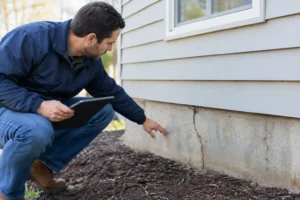
A basement wall can tell you more about a home than a freshly staged kitchen ever will. In Metro Detroit, where older housing stock, clay-heavy soils, freeze-thaw cycles, and wet springs all affect buildings differently, knowing how to assess foundation issues can protect your budget and your negotiating position.
A crack does not automatically mean a house is failing. Many homes have ordinary settling cracks, especially in plaster, drywall, and poured concrete. The question is whether the evidence points to a stable, manageable condition or an active structural or water-management problem. A careful buyer does not panic, but does not explain away warning signs either.
Start Outside Before You Enter the Basement
The exterior often provides the clearest first clues. Walk slowly around the entire home if access allows. Look at the relationship between the soil, the siding or brick, gutters, downspouts, driveway, walkways, and foundation walls.
Grade matters. Soil should generally slope away from the house so rain and melting snow drain outward rather than collect against the foundation. In communities with mature landscaping, such as Birmingham, Royal Oak, and Ferndale, years of mulch, landscaping changes, patio work, or driveway replacement can gradually raise the ground level and direct water toward the home.
Pay attention to downspouts. If they discharge right beside the foundation, they may be feeding water into the very area that needs to stay dry. A short extension can be a simple correction. But repeated wetness around a foundation can also contribute to hydrostatic pressure, seepage, and long-term movement.
You should also notice whether exterior masonry is visibly bowed, separated, or cracked in a stair-step pattern. A diagonal stair-step crack in brick does not prove a foundation failure, but it deserves closer review, particularly if the crack is wide, recently repaired, or paired with interior signs of movement.
How to Assess Foundation Issues Inside the Home
Once inside, look beyond cosmetic finishes. Sellers may have beautifully renovated a basement, but new drywall and paint do not answer structural questions. Focus on consistency: do several signs point to the same area of the house, or is there one isolated imperfection?
Read cracks by their direction and behavior
Hairline vertical cracks in poured concrete are common and may be related to normal curing or minor settlement. They still warrant a look for moisture, but they are often less concerning than horizontal cracks, long diagonal cracks, or walls that appear to lean inward.
Horizontal cracks in a basement wall can signal pressure from soil and groundwater outside the home. In block foundations, look closely for blocks that have shifted, bowed inward, or separated along mortar joints. In a finished basement, watch for uneven baseboards, patched wall sections, musty odors, or fresh paint limited to one area. These are not proof of a hidden problem, but they are reasons to ask better questions.
Do not judge a crack by size alone. Ask whether it appears old and stable, whether it has been professionally repaired, and whether it is accompanied by water stains or movement elsewhere. A qualified inspector or engineer can help distinguish cosmetic settling from a condition that needs structural work.
Check doors, windows, and floors
Sticking doors and windows are common in older homes, especially through Michigan’s changing seasons. On their own, they are not enough to diagnose a foundation concern. They become more meaningful when combined with sloping floors, large wall cracks, gaps around trim, or doors that visibly swing open or shut on their own.
Walk through the first floor and upper levels. You are not looking for a perfectly level historic home. You are looking for pronounced changes, soft spots, obvious dips, or a pattern that suggests one portion of the home is moving differently from another.
In homes with additions, pay special attention where the addition meets the original structure. Different foundation types, construction eras, and drainage patterns can create settlement differences. That does not make an addition a bad investment. It simply calls for clear documentation and a more focused inspection.
Look and smell for water evidence
Water is often the more immediate issue, even when the foundation itself is structurally sound. Check for white, chalky mineral deposits on basement walls, rust around posts or mechanical equipment, peeling paint, damp carpet edges, stains on drywall, and a persistent musty smell.
Ask whether the home has a sump pump, backup system, interior drain tile, exterior waterproofing, or a history of basement water. In Southeast Michigan, a dry basement during a showing is helpful, but it is not the full story. A seller disclosure, prior repair records, and direct questions about heavy-rain events can reveal much more.
Ask Questions That Produce Useful Answers
A seller may know very little about an older repair, particularly if the property changed hands several times. Still, vague answers should not end the conversation. Ask when the issue was discovered, what work was completed, who performed it, whether permits were obtained when required, and whether there is a transferable warranty.
Documentation matters. A paid invoice from a reputable foundation contractor, an engineer’s report, and photos of the repair are more useful than a verbal assurance that it was “taken care of.” If the repair involved wall anchors, carbon-fiber reinforcement, steel beams, waterproofing, or piering, understand what problem it addressed and whether follow-up maintenance is expected.
Also ask about insurance claims, recurring seepage, previous flooding, and any changes to drainage or landscaping. The goal is not to force a seller into a perfect answer. It is to build an accurate picture before contingencies expire.
Know When a Home Inspector Is Not Enough
A general home inspection is an essential part of a purchase, but inspectors are not typically hired to engineer a structural solution. They can identify visible concerns, document conditions, and recommend further evaluation. When that recommendation appears in the report, take it seriously.
A licensed structural engineer is often the right next step when there is visible bowing, significant horizontal cracking, evidence of ongoing movement, major floor deflection, or uncertainty about a previous structural repair. An engineer’s evaluation costs money, but it can prevent a much more expensive mistake or give you credible support during negotiations.
There is a practical trade-off. Not every small crack needs an engineer, and ordering specialty inspections for every minor imperfection can slow a transaction and add unnecessary cost. But skipping expert review when the evidence is substantial can leave a buyer accepting risk without a clear price adjustment, repair plan, or exit strategy.
For a condo, the analysis can be different. The association may be responsible for exterior foundation and drainage conditions, but buyers should still review association documents, reserve information, meeting minutes, and records of major repairs. Shared responsibility does not remove the risk if the association lacks funds or has deferred important work.
Turn Findings Into a Smart Offer Strategy
Foundation concerns should affect the terms of an offer, not just your emotions about the house. Depending on what experts find, a buyer may request repairs by a qualified contractor, seek a credit, negotiate a lower price, ask for documentation and warranties, or walk away under the inspection contingency.
The best path depends on timing and the type of repair. A seller-performed repair can be appropriate when the scope is clear and there is time to complete it properly. In other cases, a credit or price adjustment gives the buyer more control over contractor selection after closing. Be cautious about accepting a quick patch simply to keep a deal moving. The cheapest repair is not always the repair that solves the underlying drainage or structural issue.
For investors, foundation conditions should be evaluated against the full business plan: acquisition price, renovation scope, holding period, financing, rental strategy, and resale expectations. For an owner-occupant, the calculation may include comfort, future marketability, and the disruption of repairs. Either way, a home with a documented, professionally completed repair can still be a sound purchase if the price and terms reflect the facts.
A strong real estate advisor helps coordinate the right conversations, keeps deadlines visible, and makes sure concerns are addressed before you are committed. Zamzam & Associates believes clarity protects clients better than pressure ever will.
Do not let one crack decide the future of a home, but do not let a polished showing silence valid questions. Slow down, gather documentation, bring in the right expert when warranted, and make your decision with the full condition of the property in view.