
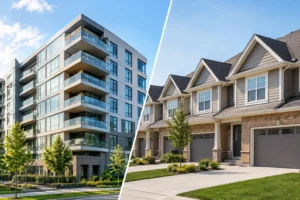
A Saturday showing can make the choice feel simple: the condo has a polished lobby, covered parking, and no lawn to mow; the townhouse has its own front door, stairs, and a little more room to breathe. But for a buyer weighing condo versus townhouse Metro Detroit options, the better fit usually comes down to the monthly budget, association rules, maintenance tolerance, and plans for the next five to 10 years.
The property type matters, but the specific community matters more. A well-run condo association in Royal Oak can be a better long-term purchase than a poorly funded townhouse community in Novi. A newer townhouse near downtown Ferndale may offer the lifestyle and resale appeal a buyer wants, while an older condo with high dues can limit financing and future flexibility. The goal is not to choose the label. It is to understand what comes with it.
Condo Versus Townhouse Metro Detroit: The Basic Difference
A condominium is generally a form of ownership, not just a building style. When you buy a condo, you usually own the interior of your unit and share ownership of common areas with other owners. Those common areas may include hallways, roofs, parking lots, landscaping, pools, elevators, and clubhouses.
A townhouse describes the home’s layout: a multi-level residence connected to neighboring homes by one or more walls. A townhouse can be legally structured as a condo, a site condominium, or, less commonly, fee-simple ownership. That distinction is not paperwork trivia. It determines who maintains the exterior, whether you own the land beneath the home, what insurance you need, and how the association can assess costs.
In Southeast Michigan, many attached townhouses are technically condominium units. Never assume that a private entrance and garage mean you have the same ownership rights and responsibilities as a detached home. Review the master deed, bylaws, budget, and rules before removing contingencies.
Start With the Monthly Cost, Not the List Price
Townhouses often list at a higher price than comparable condos because they may offer more square footage, direct-entry garages, private outdoor space, and a more house-like feel. Yet the purchase price is only one line in the real monthly cost.
Condo association dues can cover water, sewer, trash, snow removal, exterior insurance, landscaping, roof maintenance, and amenities. That can create a predictable ownership experience, especially for professionals who travel or buyers who do not want to manage contractors. It can also mean a substantial recurring payment on top of the mortgage, taxes, and insurance.
Townhouse dues may be lower, but lower is not automatically better. A low monthly fee may indicate that owners are responsible for their own roofs, siding, driveways, or exterior repairs. Or it may indicate the association is not adequately funding reserves. Both possibilities require a closer look.
Ask for the current association fee, what it covers, its recent increases, reserve balance, pending projects, and any special assessments. A $350 monthly condo fee may be reasonable if it includes utilities and strong exterior coverage. A $125 fee may be less attractive if the community expects owners to absorb a major road, roof, or drainage expense later.
Maintenance: Convenience Has a Price
For many buyers, maintenance is the deciding factor. Condo living can be particularly appealing in Birmingham, downtown Royal Oak, and parts of Ann Arbor, where location and lock-and-leave convenience are often worth more than a large yard. If the association handles snow removal, lawn care, roofing, and exterior repairs, owners have fewer weekend obligations.
That does not mean condo ownership is maintenance-free. Owners still maintain everything inside their units, including appliances, plumbing fixtures, HVAC components, windows in some communities, and damage originating within the unit. A leak from an upstairs neighbor can also create an insurance and association-management process that takes patience.
A townhouse often provides more privacy, storage, and a stronger sense of separation from neighbors. You may have a patio, deck, small yard, or driveway. Those features are valuable for families, pet owners, and buyers moving from a single-family home. They also come with responsibilities, depending on the community documents.
The right question is straightforward: what maintenance do you want to outsource, and what control do you want to keep? Buyers who want a simple lifestyle may prefer a full-service condo. Buyers who value outdoor space and more independence may lean townhouse, provided they are comfortable with the upkeep.
Rules, Rentals, and Everyday Flexibility
Every condominium or townhouse community has rules. Some are sensible protections for property values. Others can affect how you live in the home.
Before submitting an offer, confirm pet restrictions, parking rules, guest parking availability, move-in procedures, exterior modification policies, and leasing limitations. A buyer who works from home may need to know whether commercial vehicles are restricted. An investor needs clear answers on rental caps, minimum lease terms, approval requirements, and whether the association allows new leases at all.
These issues matter across Metro Detroit, where community standards vary widely. A newer development in Troy or Rochester Hills may have stricter architectural and leasing controls than a smaller, older association. Neither is inherently better. The community must match your intended use of the property.
Do not rely on a listing description or a verbal answer alone. The governing documents control. A careful review protects buyers from discovering, after closing, that their dog exceeds a weight limit or their intended rental strategy is prohibited.
Financing Can Change the Equation
Financing a townhouse is often similar to financing a single-family home when it is fee-simple. Condo financing can involve another layer of lender review. Depending on the loan program, the lender may evaluate the association’s insurance, budget, owner-occupancy level, litigation history, and financial condition.
This does not mean condos are difficult to finance. Many are financed every day. It does mean buyers should involve their lender early and provide the association information quickly. A community with deferred maintenance, inadequate insurance, or a high number of rentals may create loan restrictions for some buyers.
For FHA, VA, and certain conventional loans, approval requirements can be especially relevant. Cash buyers and conventional buyers with flexible lending options may have more choices, but resale matters too. A property that only a narrow group of future buyers can finance may take longer to sell or face pricing pressure.
Resale Value Is About Demand and Management
A townhouse often attracts buyers who want the space and function of a home without the full scale of detached-home maintenance. That broad appeal can support resale, particularly near strong employment centers, walkable downtowns, and highly regarded school districts.
Condos can also hold value well when they offer what cannot easily be replicated: a central location, secure parking, updated common areas, views, elevators, or true maintenance convenience. In markets where downsizers, young professionals, and second-home buyers compete for close-in locations, a well-managed condo can be highly desirable.
The weak point is rarely the property type alone. It is usually poor association health, dated common areas, escalating dues without a clear benefit, weak reserves, or restrictive rules that reduce the buyer pool. Review meeting minutes for recurring complaints, major upcoming repairs, insurance claims, and disputes. A clean, orderly community with transparent leadership is a real asset.
When a Condo Is the Better Fit
A condo may be the better choice if you want to live near restaurants, offices, or entertainment, prefer minimal exterior responsibility, and value predictable services. It can also work well for a first-time buyer who wants ownership without yard work, a busy executive who travels frequently, or a downsizer who wants to stay near family without maintaining a large home.
The best condo purchase is not necessarily the one with the lowest dues. It is the one where the dues, reserves, condition, and lifestyle all make sense together.
When a Townhouse Is the Better Fit
A townhouse may be the stronger fit if you need more bedrooms, a garage, storage, private outdoor space, or a layout that feels closer to a detached home. It can be a practical middle ground for move-up buyers priced out of certain single-family neighborhoods, especially in areas such as Novi, West Bloomfield, Troy, and Canton.
Look carefully at shared walls, parking, guest access, stairs, and exterior responsibilities. A townhouse gives many buyers welcome space, but not every townhouse community gives the same level of privacy or control.
A smart purchase starts with clear expectations, not a preference for one label over another. Zamzam & Associates can help buyers compare the association documents, financing considerations, monthly carrying costs, and neighborhood-level resale factors before a decision becomes a commitment.